

Kiran Deep Sandhu | Leadership Communication Coach
Why the most prepared leaders often have the least influence — and the shift that changes everything.
You prepared well. You knew your content. You walked into that meeting — the boardroom, the team call, the client conversation — and said everything you planned to say.
And somehow, nothing moved.
People nodded. The meeting ended. You walked out with that nagging feeling that despite doing everything right, you hadn’t really landed.
I’ve sat across from this more times than I can count — leaders who are sharp, well-prepared, genuinely capable — and still struggling to create the influence they’re capable of.
The problem is almost never what they’re saying. It’s the game they think they’re playing when they say it.
Two Ways to Walk Into a Room
Simon Sinek, in The Infinite Game, describes two kinds of games.
A finite game has a clear end point — a result, a winner, a score. You play to win, it ends, you move on.
An infinite game has no end point. No final score. The goal isn’t to win. It’s to keep playing, keep building, keep going.
Leadership is an infinite game. So is communication.
But most leaders walk into rooms playing a finite game. They want to win the argument. Land the pitch. Get the approval. Convince the sceptic. Walk out having won something.
Communicating to win is a finite game. You might win the room today and quietly lose their trust over time. Real influence doesn’t work on a scoreboard that resets after every meeting.
The leaders with lasting influence are playing something different entirely. They’re not trying to win the room. They’re trying to move people — toward a decision, a direction, a possibility they hadn’t quite seen before. That’s an infinite game. And it requires a completely different way of showing up.
Does This Sound Familiar?
You prepared everything. The data, the deck, the answer to every objection you could anticipate. And you still didn’t get the outcome you needed.
Because influence doesn’t come from having the best argument. It comes from the relationship the other person has with you before you open your mouth. Finite thinkers prepare content. Infinite thinkers build trust — over time, quietly, in every interaction long before the meeting that matters.
Or this one: you left the conversation feeling like you had to perform — and it exhausted you.
That’s what finite communication does. When every conversation is a game to win, every room is a stage and every interaction is a test. No wonder it drains you. The leaders who communicate with ease aren’t performing. They’re just being — clearly, consistently, without needing to prove anything.
Where the SPEAK Influence Framework Comes In
Over years of coaching leaders, I developed the SPEAK Influence Framework — five elements that together build the kind of communication that creates lasting influence, not just short-term wins. Each one, at its core, is an infinite game skill.
S Self-Awareness- A finite communicator walks into a room asking: how do I win this? An infinite communicator walks in asking: what does this person or room need from me today?
Self-awareness is what lets you catch yourself mid-sentence and notice — I’m defending, not leading. I’m performing, not connecting. That awareness, in the moment, is where influence actually begins. Without it, even the best communication skills become tools in the wrong hands.
P Powerful Presence and Persuasive Communication-Presence under pressure is a different thing from confidence in theory. I know this because I’ve tested it in the hardest way I know.
Before my TEDx talk, I went to the venue the night before — not to rehearse, but to stand on the stage. To feel the space before it became a performance. Five minutes before my turn, I put on headphones, played calming music, and made one decision: I am not here to perform. I am here to connect.
In my very first sentence, I stumbled.
Instead of panicking, I paused. I breathed. And I came back to that decision: not perfection. Connection. As the talk went on, the audience responded — not to the words, but to something they felt was real. Afterwards, a senior naval officer who had led a tsunami rescue mission walked over to congratulate me. The MC said something I’ve carried with me since: “We don’t need to introduce Kiran Deep Sandhu. Her speech itself is an introduction to the impactful work she is doing.”
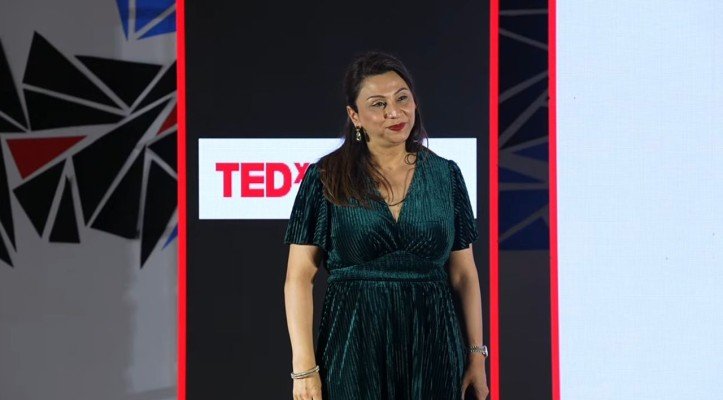
Author on the TEDx Stage
I’ve seen this same pattern with leaders I coach. A department head — sharp, analytical, never short of good ideas — whose contributions kept being overlooked in meetings. Not because of what she said. Because of how she was showing up when she said it. Once that shifted, so did everything else. Within two months, she was asked to lead a regional initiative.
Persuasion doesn’t require you to be louder. It requires you to be clearer — from the inside out.
E Emotional Intelligence-You cannot read the room if you’re busy trying to win it.
Finite thinking makes leaders reactive — anxious about how they’re landing, threatened by pushback, thrown off by silence. Emotional intelligence in communication means staying steady while the room isn’t. It means noticing what’s happening beneath the words — the hesitation in a yes, the frustration behind a question, the disengagement that looks like politeness.
Infinite communicators stay curious. They don’t need the room to validate them in order to keep going.
A Authentic Authority- Authority borrowed from your title is finite. Authority earned through consistency is infinite.
I work with leaders who have impressive designations and struggle to be heard — and leaders with no formal authority who move entire organisations. The difference is almost always authenticity. Authentic authority comes from saying what you mean, meaning what you say, and doing it consistently enough that people stop questioning your motives.
You cannot project authentic authority while chasing approval. The two cancel each other out.
K Key Leadership Competencies-The competencies that matter most in leadership communication are all long games. Storytelling. Active listening. Clarity under pressure. Giving feedback that lands without destroying.
None of these produce immediate wins. They compound. A leader who communicates with clarity and care, consistently, over months and years — builds something no single brilliant presentation ever could. Reputation. Trust. The kind of influence that doesn’t need a room to work.
One Question Before Your Next Important Conversation
I ask this of coaching clients before any high-stakes communication — a boardroom presentation, a difficult conversation, a team address.
“Am I walking in to WIN this —
or to MOVE someone forward?”
If the answer is about winning — getting approval, proving a point, not looking weak — you may walk out having won. But something will feel hollow about it.
If the answer is about moving someone — toward a decision, a possibility, a better version of themselves — the conversation may be harder. But the influence will last.
What I’ve Learned
The shift from finite to infinite communication is not about becoming softer or less direct. The best leaders I know are direct, clear, and completely unafraid of difficult conversations.
What changes is the intention underneath the words. Are you speaking to protect yourself — or to serve the person in front of you? That intention is felt before you finish your first sentence. And it shapes everything that follows.
The leaders who sustain real influence over time are not the ones who always win the room. They are the ones who keep showing up — clearly, consistently, with something to give rather than something to prove.
That is the infinite communicator. And that is the leader people choose to follow.
Want to explore the SPEAK Influence Framework?
I work with leaders and leadership teams on communication, presence, and influence — through coaching, workshops, and leadership programmes organized under my coaching/training company- Leadership KARD.If you’re ready to lead with more clarity and less effort, a discovery call is the place to start. Book your discovery call here: topmate.io/kiran_deep_sandhu
About the Author
Kiran Deep Sandhu
Kiran Deep Sandhu is a Leadership Communication Coach and Founder of GBTC Trust . She works with leaders, leadership teams, and organisations on communication, presence, and influence — through the SPEAK Influence Framework. Her work sits at the intersection of communication coaching, leadership development, and education.